
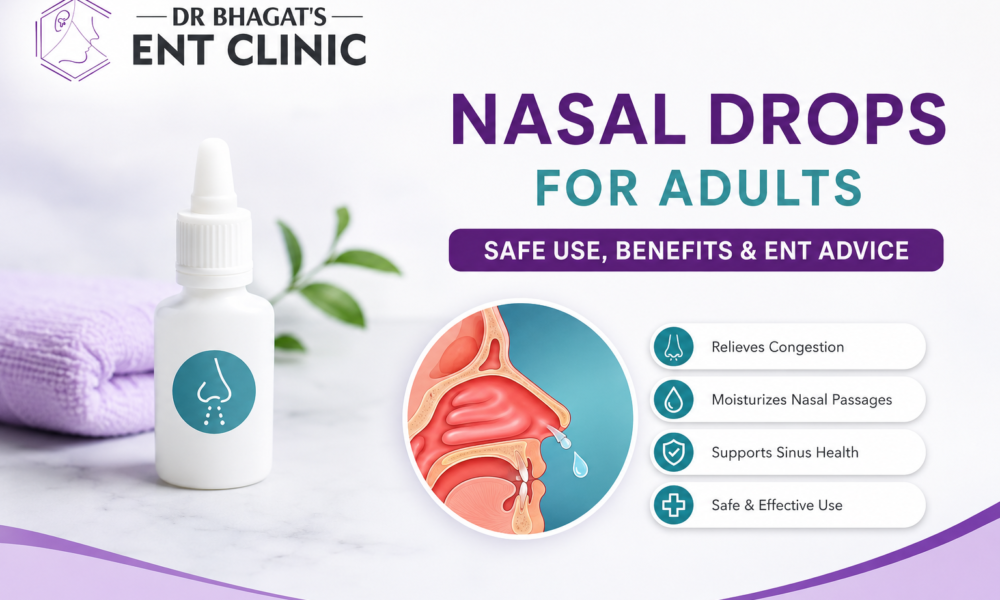
Nasal congestion can make breathing uncomfortable, disturb sleep, and affect concentration throughout the day. When the nose feels blocked, many adults look for quick relief and search for nasal drops for adults. Nasal drops can be useful for certain nasal conditions, but the right product and method of use depend on the underlying cause of congestion.
A blocked nose may occur because of a common cold, allergies, sinus problems, nasal inflammation, or structural issues such as a deviated nasal septum. Because these conditions can require different approaches, choosing nasal drops for adults based only on symptoms may not always provide lasting relief.
Dr. Monika Bhagat’s ENT clinic in Hadapsar, Pune, provides specialized nose and sinus care for conditions including sinusitis, allergies, nasal blockage, sneezing, snoring, and breathing problems. The clinic focuses on advanced ENT diagnosis and personalized treatment plans for adults and children.
What Are Nasal Drops?
Nasal drops are liquid medicines or saline solutions administered directly into the nostrils. Depending on their ingredients, they may help moisturize the nasal passages, loosen mucus, reduce congestion, or manage specific nasal conditions.
However, not all nasal drops for adults work in the same way. Some are simple saline preparations, while others contain medicines designed to reduce nasal swelling. Using the wrong type for too long may fail to address the underlying problem or, in some cases, cause additional nasal symptoms.
This is why understanding the purpose of a nasal drop is important before starting regular use.
Why Do Adults Use Nasal Drops?
Adults may consider nasal drops for adults when they experience nasal blockage, dryness, excessive mucus, allergy-related symptoms, or difficulty breathing through the nose.
A blocked nose can be particularly uncomfortable at night. Nasal congestion may make it difficult to sleep comfortably and can sometimes contribute to mouth breathing or snoring.
The cause of the blockage matters. A person with seasonal allergies may require a different treatment approach from someone with sinus inflammation or a structural nasal problem.
Dr. Monika Bhagat’s website specifically highlights personalized treatment for sinusitis, allergies, nasal blockage, sneezing, snoring, and breathing problems.
Common Reasons for Nasal Congestion
| Possible Cause | Common Symptoms | Possible ENT Approach |
|---|---|---|
| Common cold | Congestion, runny nose, sneezing | Supportive care and symptom management |
| Allergies | Sneezing, itching, watery discharge | Allergy-focused treatment |
| Sinus problems | Congestion, facial pressure, mucus | Sinus evaluation |
| Nasal dryness | Dryness, irritation, crusting | Moisturizing or saline care |
| Structural blockage | Persistent difficulty breathing | ENT examination |
| Nasal inflammation | Swelling and blocked nose | Medical evaluation |
These symptoms can overlap, so persistent congestion should be evaluated instead of repeatedly using nasal drops for adults without identifying the cause.
Are Nasal Drops Safe for Adults?
The safety of nasal drops for adults depends on the type of product, how often it is used, and the individual’s health condition.
Saline nasal preparations are generally used to moisturize the nasal passages and help clear mucus. Medicated decongestant products are different and may have restrictions regarding how frequently or how long they should be used.
Adults should always read the product instructions and follow advice from a doctor or pharmacist. People with certain health conditions or those taking other medicines may need additional guidance before using medicated nasal products.
If congestion continues despite treatment, repeatedly increasing the frequency of nasal drops for adults is not a good solution. Persistent symptoms may indicate an underlying condition that requires professional assessment.
Saline Nasal Drops vs Medicated Nasal Drops
One of the most important distinctions is between saline products and medicated nasal drops.
Saline products contain salt and water and are primarily used to moisturize the nose and help clear mucus. They do not work in exactly the same way as medicated decongestant products.
Medicated decongestants can temporarily reduce swelling inside the nose and make breathing easier. However, some decongestant nasal products are intended for short-term use. Prolonged or excessive use can result in worsening congestion, sometimes called rebound congestion.
| Type | Main Purpose | Important Consideration |
|---|---|---|
| Saline drops | Moisturize and help clear mucus | Generally used according to product directions |
| Saline spray | Moisturize and rinse nasal passages | Useful for routine nasal hygiene |
| Medicated decongestant | Temporarily reduce nasal swelling | Should not be overused |
| Prescription nasal medicine | Treat specific nasal conditions | Should be used according to medical advice |
Therefore, choosing nasal drops for adults should depend on the symptoms and the product’s active ingredients rather than simply selecting the strongest option available.
How to Use Nasal Drops Correctly
Using nasal drops for adults correctly can help ensure that the product reaches the nasal passages effectively.
Before using a nasal product, wash your hands and follow the instructions provided with the medicine. Avoid touching the dropper tip against the inside of the nose because this can contaminate the product.
Tilt your head according to the product instructions and administer the recommended amount. Do not automatically increase the number of drops because the nose feels more blocked.
If you are using a medicated product, follow the recommended duration carefully. If symptoms continue after the suggested period, consult an ENT specialist rather than continuing the product indefinitely.
Can Nasal Drops Be Used Every Day?
Whether nasal drops for adults can be used daily depends on what type of drops you are using.
Saline products may be used as part of nasal care according to their instructions. Medicated decongestant drops are different and may be intended only for short-term use.
Using certain decongestant nasal products for too long can lead to rebound congestion. This can create a cycle where the nose feels increasingly blocked when the medicine wears off, encouraging repeated use.
If you feel that you need nasal drops for adults every day just to breathe comfortably, it is worth discussing the problem with an ENT specialist.
Persistent nasal blockage may be associated with allergies, chronic sinus inflammation, enlarged nasal structures, a deviated septum, or another condition that requires a more targeted treatment approach.
What Happens If You Overuse Decongestant Nasal Drops?
One of the most important concerns with certain medicated nasal drops for adults is overuse.
A decongestant may provide rapid temporary relief by reducing swelling in the nasal lining. However, using it beyond the recommended duration can sometimes cause the congestion to return or become worse.
This can lead to repeated use, creating a cycle that is difficult to break without addressing the underlying problem.
If you have been using a medicated nasal product for longer than recommended and your congestion is continuing, speak with a doctor or ENT specialist. Do not simply increase the dose or frequency on your own.
Nasal Drops for Adults With Allergies
Allergies are a common reason for recurring nasal blockage and sneezing. People with allergic rhinitis may experience congestion, repeated sneezing, nasal itching, and watery nasal discharge.
In such cases, nasal drops for adults may not be the only treatment consideration. The appropriate approach depends on the severity of symptoms and the underlying allergy.
Reducing exposure to known triggers and following a personalized treatment plan may be more effective than repeatedly using a temporary decongestant.
Dr. Monika Bhagat’s clinic provides specialized sinus and allergy care, including management of allergies, sneezing, nasal blockage, and related breathing concerns.
Nasal Drops for Sinus Problems
Sinus problems can cause congestion, facial pressure, mucus, reduced sense of smell, and difficulty breathing through the nose.
While nasal drops for adults may provide temporary relief in some situations, persistent sinus symptoms should not be managed only with repeated self-medication.
A specialist can assess the nose and sinuses and determine whether symptoms are associated with infection, inflammation, allergies, or structural factors.
Dr. Monika Bhagat’s practice specifically offers nose and sinus care for sinusitis, allergies, nasal blockage, sneezing, and breathing problems.
When Nasal Congestion Needs an ENT Evaluation
Consider an ENT consultation if nasal blockage is persistent, repeatedly returns, affects sleep, interferes with exercise or daily activities, or occurs with significant facial pressure or other concerning symptoms.
An ENT evaluation can help determine whether the problem is primarily related to allergies, sinus disease, inflammation, or nasal anatomy.
Instead of continuously changing nasal drops for adults, identifying the underlying cause can lead to a more appropriate and sustainable treatment plan.
Can Nasal Drops Help With a Blocked Nose?
Yes, some nasal products can temporarily help relieve a blocked nose, but their effectiveness depends on why the nose is blocked.
For example, saline preparations can help moisturize the nasal passages and clear mucus. Certain medicated products can temporarily reduce swelling.
However, nasal drops for adults should not be considered a universal solution for every type of nasal blockage.
If the blockage is caused by a structural problem or a persistent ENT condition, drops alone may not resolve the underlying issue.
What About Nasal Drops and Throat Problems?
Nasal and throat symptoms can sometimes occur together because mucus from the nose can drain toward the throat. This is known as postnasal drainage and may contribute to throat irritation or coughing.
People sometimes search for for throat pain medicine, for throat infection antibiotics, or an antibiotic for throat pain when they have both nasal and throat symptoms.
However, throat pain does not automatically mean that antibiotics are required. Similarly, nasal congestion does not automatically mean that a medicated nasal product is the right treatment.
The underlying cause should be evaluated before starting medication.
Should You Take Antibiotics for Nasal Congestion?
Antibiotics are not a routine treatment for simple nasal congestion. Many cases of congestion are related to viral infections, allergies, or inflammation rather than bacterial infections.
People searching for the best antibiotic for sore throat infection, antibiotics for throat pain, or other antibiotic-related treatments should avoid self-medication.
Antibiotics should be used only when a qualified healthcare professional determines that a bacterial infection is present or sufficiently suspected to require treatment.
The same principle applies to nasal drops for adults. Choosing treatment based on the cause is more important than choosing a medicine simply because it provides quick temporary relief.
Why Consult an ENT Specialist?
An ENT specialist can evaluate the complete picture when symptoms involve the nose, sinuses, ears, throat, or breathing.
Dr. Monika Bhagat’s clinic focuses on comprehensive ENT diagnosis and personalized treatment for ear, nose, throat, sinus, hearing, balance, and sleep-related conditions. The practice also offers advanced ENT procedures and medical and minimally invasive surgical treatment options when appropriate.
If you regularly depend on nasal drops for adults to breathe comfortably, an ENT evaluation can help determine why the congestion is occurring and whether a more suitable treatment is required.
When Should You Stop Self-Treating Nasal Congestion?
Occasional congestion may improve with simple supportive measures. However, persistent or recurring nasal symptoms deserve greater attention.
You should consider professional evaluation when congestion continues for an extended period, repeatedly returns, significantly affects sleep, occurs with recurrent sinus symptoms, or does not improve despite appropriate treatment.
If you have been repeatedly using nasal drops for adults without lasting improvement, continuing the same approach may not solve the underlying problem.
An ENT specialist can assess the nasal passages and determine whether further evaluation or treatment is required.
Why Choose Dr. Monika Bhagat for Nose and Sinus Care?
Dr. Monika Bhagat is an ENT specialist based in Hadapsar, Pune, providing care for adults and children with a range of ear, nose, and throat conditions.
Her clinic’s nose and sinus services include care for sinusitis, allergies, nasal blockage, sneezing, snoring, and breathing problems. The clinic emphasizes advanced diagnosis and personalized treatment plans based on individual symptoms and needs. (drmonikabhagatent.com –)
For adults who regularly search for nasal drops for adults because of recurring congestion, professional evaluation can help identify the reason for the problem and guide appropriate treatment.
The clinic also provides hearing and balance evaluation, advanced head and neck care, and in-office ENT care, allowing patients to receive comprehensive assessment when symptoms overlap between different ENT areas.
Conclusion
Nasal drops for adults can be useful for certain nasal symptoms, but the appropriate product depends on the cause of congestion. Saline products and medicated nasal decongestants work differently, and medicated products should be used according to professional and product guidance.
If nasal congestion keeps returning or you need nasal drops for adults frequently just to breathe comfortably, it may be time to look beyond temporary relief. Allergies, sinus problems, inflammation, and structural nasal conditions can all contribute to persistent blockage.
It is also important not to confuse nasal symptoms with bacterial throat infections. Searching for for throat infection antibiotics, an antibiotic for throat pain, or the best antibiotic for sore throat infection does not replace a proper diagnosis.
An ENT consultation can help identify the underlying cause and determine the most appropriate treatment approach.
Book an ENT Consultation in Pune
If you are frequently using nasal drops for adults because of nasal blockage, allergies, sinus problems, or breathing difficulties, consider getting your symptoms evaluated by an ENT specialist.
Need ENT Consultation? Call Us:
+91 735 091 2925
Email:
drmonikabhagat@gmail.com
Our Address:
303B, The Cosmopolis, Opposite of SEASONS MALL, Hadapsar, Pune
Book an ENT consultation with Dr. Monika Bhagat for personalized evaluation and treatment guidance.
Frequently Asked Questions
1. What are nasal drops for adults used for?
Nasal drops for adults may be used for different purposes depending on their ingredients. Saline products can help moisturize the nose and clear mucus, while some medicated products can temporarily reduce nasal congestion.
2. Can I use nasal drops every day?
It depends on the type of product. Saline preparations and medicated decongestants have different usage considerations. Some medicated decongestant products should only be used for a short period. Always follow the product instructions or your doctor’s advice.
3. Can overusing nasal drops make congestion worse?
Yes, certain medicated decongestant products can cause rebound congestion when overused. If you find yourself relying on nasal drops for adults regularly, consult an ENT specialist rather than increasing the frequency yourself.
4. Are nasal drops useful for allergies?
Some nasal products may be part of an allergy treatment plan, but the appropriate medicine depends on the symptoms and severity of the allergy. Persistent allergic symptoms should be evaluated by a healthcare professional.
5. Should I use nasal drops for sinus problems?
The appropriate treatment depends on the cause of the sinus symptoms. Nasal drops for adults may provide symptom relief in some situations, but recurring or persistent sinus problems may require an ENT evaluation.
6. When should I see an ENT specialist for nasal blockage?
Consider an ENT consultation when nasal blockage is persistent, recurrent, affects sleep or daily activities, or does not improve with appropriate treatment. An ENT specialist can investigate possible causes such as allergies, sinus problems, inflammation, or structural blockage.
7. Can nasal congestion cause throat discomfort?
Yes. Nasal congestion and postnasal drainage can sometimes contribute to throat irritation or coughing. However, persistent throat pain should be evaluated rather than automatically treated with antibiotics.
8. Should I take antibiotics along with nasal drops?
Not automatically. Antibiotics are used for certain bacterial infections, while nasal products are used for specific nasal symptoms or conditions. A doctor should determine whether antibiotics are appropriate based on the diagnosis.